Wednesday, July 8, 2020

Time Management


7 Essential Time Management Skills and Strategies for Work | LiquidPlanner
Time management can be harder to obtain coming into your first year. You have a lot more freedom and a lot more choices to make regarding your time. In high school, my schedule looked similar to this: school from 7:45-3, practice from 3:15-5:00, work from 5:30-9. In college, my schedule is much different. I have classes at different times every day, club meetings and club related events at different times every week, office hours to keep track of, sporting events, etc. My biggest piece of advice regarding time management is make google calendar your best friend. Each semester the way I manage my time adjusts slightly. I’ll share with you how I find a routine and schedule that makes the most efficient use of my time at the beginning of each semester.


Steps to organizing your calendar:

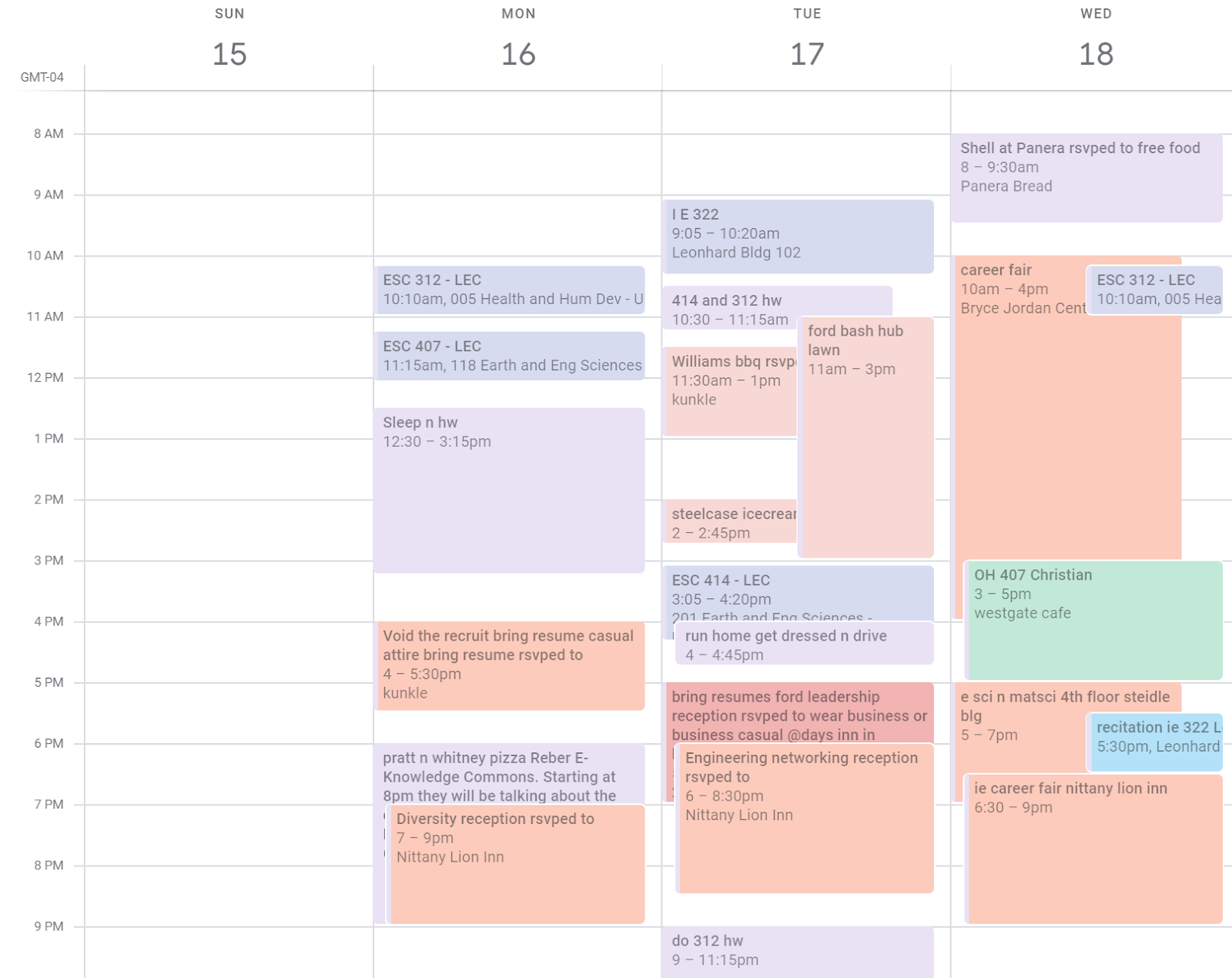
  • Enter each different category of activity in a different color as a way of prioritizing (and making my calendar look nice).  
  • Start by putting all of your classes in google calendar. 
  • Then, use a different color to put on all of my professors office hours. I ignore the office hours that are during one of my other classes since I won’t be able to attend them. Keep in mind that you most likely won’t be going to all of your professors’ office hours every week but I like to put them on my calendar so I don’t have to keep going back to the syllabus to find the hours. A lot of professors will also offer extra credit for attending LA/TA (learning assistant/teaching assistant) help sessions. For these classes there will most likely be a lot of options each week so I recommend finding one that works with your schedule and going to the same one each week to help you keep a steady routine. 
  • Add all of the exams that have already been scheduled. 
  • Add in weekly deadlines for assignments and quizzes.  
  • Next, look up the schedules for the sporting events you plan on attending. For example, in the fall I enter all of the home football games and in the spring all of the home lacrosse games. 
  • If you join a club that has a meeting at the same time on the same day, enter that in. Some clubs have events going on each week that are going to change based on the week. These events will most likely be sent out to you in a weekly email. A lot of clubs also have a google calendar that you can import into your personal calendar if you don’t want to input all of the events manually. 
  • Finally, use the ‘all day’ button to add events that take place over multiple days. By doing this, it doesn’t clutter up your calendar but it adds a small bar at the top of each day to remind you that the event is occurring. For example, I do this for parents weekend to remind myself that I will probably have less time to do homework that weekend. I also do it for homecoming week since there are a lot of extra events that occur that week.

    Below is an example of what my google calendar looks like for any given week. 
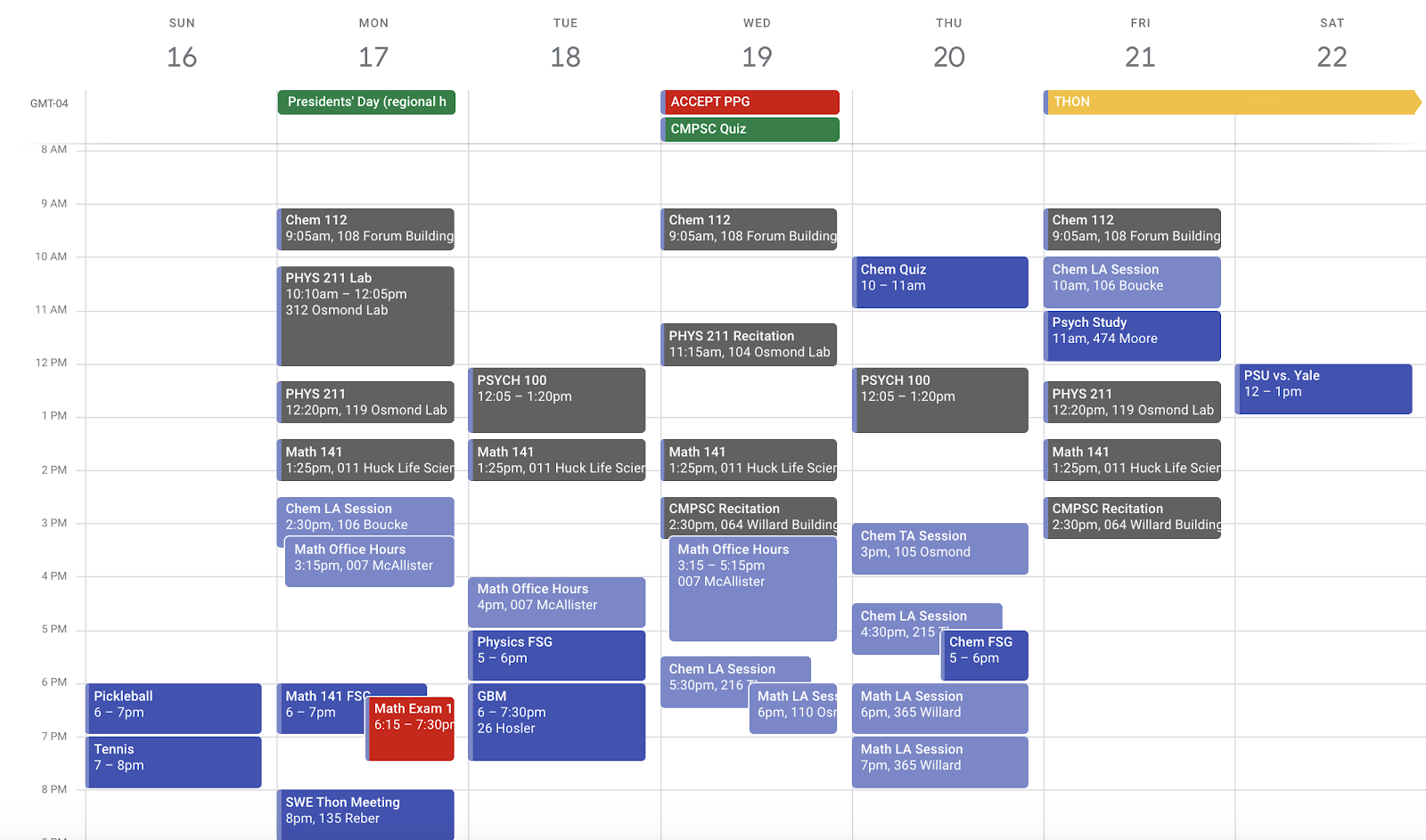


Now that you have all of your scheduled events in your calendar, you can see where you have gaps of time to do homework, go to the gym, grab lunch with friends, etc. I highly recommend not going back to your dorm between classes. Instead, find a spot where you can focus and get some homework done. There is most likely a good work place within a five minute walk of all of your classes. You would be surprised how much more you can get done with the extra 20 minutes that you save by not walking all the way back to your dorm (this is especially true if you live in East Halls since it is farther from most classes). Keep in mind that everybody manages time differently. Don’t compare your schedule to others because what is working for them may not work for you. For example, I know some people that work out at 7 am and others that work out at 9pm. I also know some people that sleep from 11pm-7am and others that sleep from 4am-8am and then take a nap in the afternoon. What is great about making your schedule in college is that it is centered around you. You don’t have siblings to worry about or having to get up at 6am for school or having to eat dinner at a certain time. You can adjust it to whatever works best for you. If you plan on attending a lot of events for clubs throughout the week, I recommend finding a block of time on the weekends where you can get a head start on a lot of your assignments. My friends and I personally had a routine where we would have brunch on Sunday mornings then head to the library where we got a lot of work done for the upcoming week. On occasion this time would be filled with other things but we did our best to keep our schedules open for at least a few hours. 
11 Time Management Tips That Really Work
Finally, time management is a skill that doesn’t always come easy. Don’t worry if it takes you a little while to get into a routine that works for you. Don’t worry if the girl next door can do 100 things in a week while you can only manage to do 25. We are all in different situations so find what works best for you. 

Sarah Kohr
Team D Envoy

Make Professors Your Ally

A big switch from high school is going to be the classroom dynamic. There won’t be people you’ve known for years sitting next to you, and you have probably never heard of the professor. You will also spend a lot less time in the classroom, so the relationship with your professor is going to be a little harder to build, but I’m going to teach you how to do it.

Meet your professors!


Let’s get real! Some classes your first semester will have 200+ people, and others will have less than 30. Regardless, all of these professors will offer office hours. These are CRUCIAL! Go to your professors office hours the first week. This is a great time because you won’t be too busy with assignments and neither will they. Go to them and just introduce yourself, and tell them your background in the subject (even if it’s your first class in that subject, let them know). This is a great way to start conversation with them. They are happy to have students stop by and build relationships with them. Remember, your professors are human. They love to meet their students and help them in their studies. 


Put office hours in your schedule


As classes pick up, assess which classes you will need the most help in. My first semester, I decided that it was Math 141 for me. I made time each week to go to my professors office hours to check my homework and ask any questions. This doesn’t mean you can only choose one class to do this for, that is just how I did it, but the more professors you know the better off you will be. Do your best to build time into your weekly schedule to go to office hours. Maintaining this will show your professor that you care about the class and are doing your best. It will also give you a much deeper understanding of the topic if you are getting help from your professor so often. Their office hours will not be very crowded if it is not near an exam day which means there will also be time to talk to them and get to know them. Learn about their research and their academic background. Maybe they can help guide you and help you find what you are interested in. Professors know a lot more than just the class they teach. One on one time with a professor is super valuable, take an advantage of it whenever you can.

Office hours get overwhelming the week of an exam. 
Especially in big classes, there will be tons of students trying to get to these last minute office hours. It is hard to get your questions answered and you will not get the same sort of attention. This is not the same as going regularly, and often the professor will see so many people that week, you will not stand out. This is why it is important to see your professors beforehand and not save everything for the last minute. 

Why is it important to know your professor?

Having this relationship is very beneficial for multiple reasons. First and foremost, the class itself will be a little easier because you are not holding on to any questions and you are proactively looking at the material ahead of time. The other great benefit is creating this strong relationship with your professor will put you in a great position when unexpected things happen. Examples of this might be having to miss a class because you had to go home, or if you need an extension on some work. Your professor will be much more lenient and caring for you if they know you and know you care about the class. A great example of this was the spring 2020 semester when COVID struck. We were all unexpectedly sent home and faced tons of issues. I had built a relationship with my professors, so when I ran into issues (which I did multiple times) they were really accommodating and helpful because they knew me personally and knew I cared about their classes. You will also eventually need letters of recommendation (for scholarships, study abroad, leadership positions, grad school, etc.) and if you do not have a personal connection with a professor, it will be hard to get a good one. Professors might also offer you opportunities to work with them in their research, as a teaching assistant, or grader! 
Your professors can be your mentors and ally, you just have to put yourself in the position to make it possible. 

Other Tips and Tricks to Build a Relationship With Your Professor

  • Sit in the front
    - This is an underrated method that professors DO NOTICE! I had professors give me points back on exams because they saw me in class everyday since I sat in the front.
  • Ask questions in class (if you have them)
  • If your professor asks a question, don't be shy, answer it!
    - While sometimes it's intimidating to raise your hand, no one will judge you for doing it and your professor will appreciate it.
  •  Go to class
    - Self explanatory, but easy to do and very important!
  • Know what your professor wants to be called (Dr.,Mrs./Mr., first name)
    - If they do not give you permission to call them by their first name, don't try it!
You do not need to be going to office hours three times a week for every class, but make sure all of your professors know who you are and take time to get to know your professors early.

Andrea Castsaneda
Team D Mentor

Study Tips

One of the most intimidating aspects of college may be exams, but there are many ways to prepare yourself to be successful. As one professor said, “It’s a celebration of knowledge!” This statement is most certainly true, although it may be hard to admit. It’s your chance to demonstrate all that you know to not only your professors, but also yourself. Feeling prepared for an exam looks different for many people, but I will give you advice that can set you off on the right foot once the school year begins!

Have a Planner

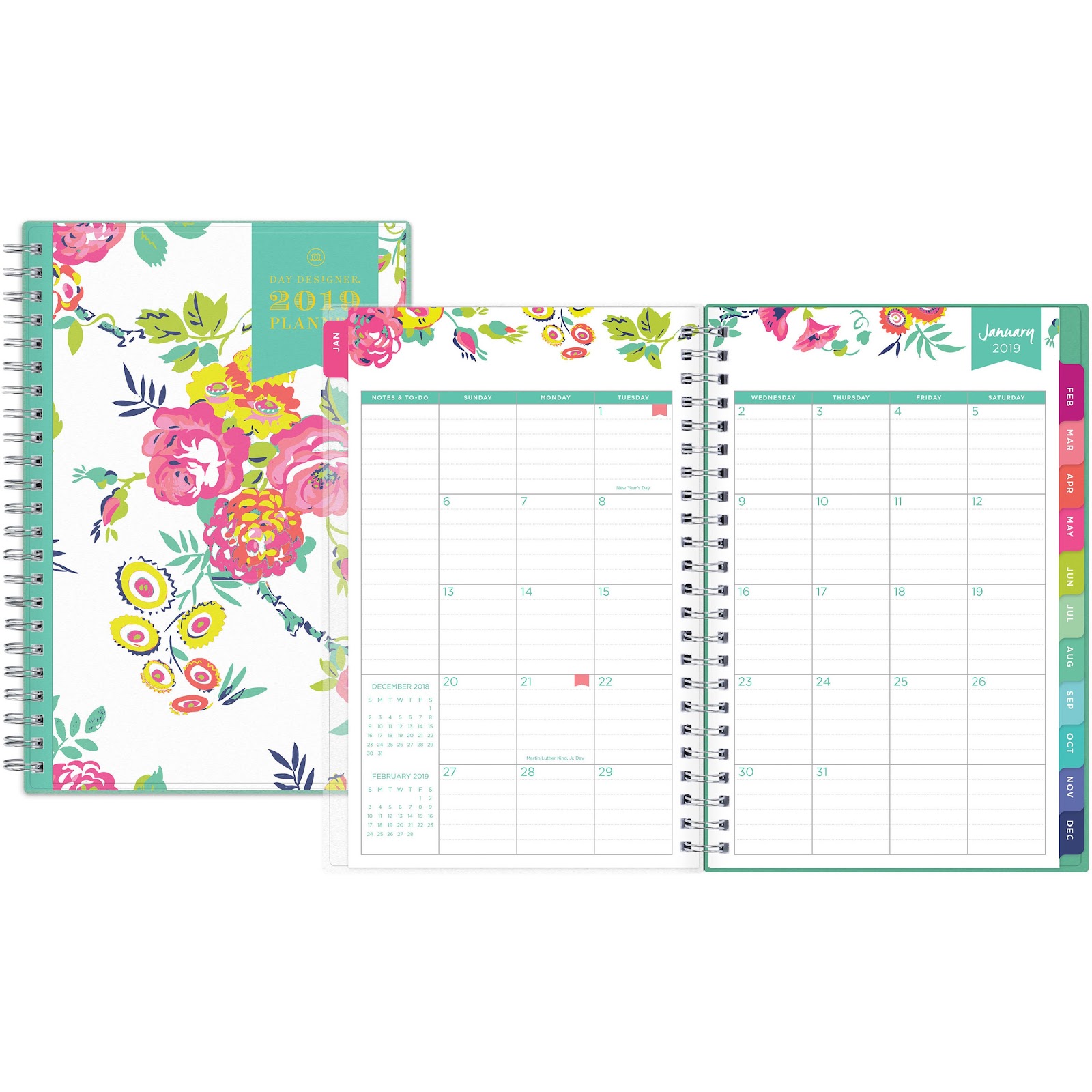
First and foremost, have somewhere to organize when you have upcoming assignments, study groups, exams and whatever else you have. I highly recommend planners from Target by the brand Blue Sky, I have loved them for several years now! It’s very helpful to put important dates in ahead of time so that you are less likely to forget them. Personally, once I received a syllabus from a professor on the first day of classes, I went into my planner later on and wrote in important dates so that they would be there when I needed them. This is very helpful to gage when you have exams for which classes, and how you want to allocate your time to study for each course. You also can see when you will have more free time WAY in advance!


Try Guided Study Groups and Exam Reviews


Coming to college is a really exciting time in life, but recognize when to have fun and when to put school first. Penn State has a lot to offer academically and socially. It’s easy to get lost in all of it, but know that there are resources to help you succeed! Being responsible doesn’t just mean being smart by sitting down to study, but also getting the help that you need. For example, many pre-requisite courses have guided study groups offered once or several times a week even, that are designed to help YOU succeed. It can be hard to admit to yourself that you need help. Taking that step and attending a study session with other students can help better your understanding in a course, and you may also be lucky enough to make friends here as well. In addition to GSGs, many courses offer exam reviews. This can vary from course to course, but in many cases, a professor, teaching assistant (TA) or learning assistant (LA) will work through a practice exam in front of students. Personally these exam reviews made a huge difference in my Chem 110 experience. I loved Todd Pontius (right), who offered exam reviews for each exam and then some. My friends and I truly enjoyed attending his exam reviews and would get somewhat excited to take the chemistry exams. I acknowledge that these resources do not work for every student, but do not be afraid to try something new during your semesters at PSU despite what your friends do!


Understand Which Friends You Can Study With


If you’re anything like me, you’re going into Penn State with lots of friends from high school but they are ALL studying business. As much as I love these friends, I learned quickly it does not work for me to study with any of these people! I am very grateful to have met my best friend last year at WEPO (shoutout to Catherine Cavanaugh!), and her and I learned to study together. It can be helpful to have other people motivating you to study. This can allow you to find new study techniques or meet new people. 

Set goals of When to Start Studying


Compared to high school, you will likely need to spend more time studying for exams, and with that being said it’s better to start sooner rather than later. Of course it’s beneficial to study the material each night as it’s being taught, but with the amount of workload you have that may feel impossible. I would recommend starting a week out from any exam. Begin by going through any notes, homeworks and previous assessments. Organize whatever you’ve been told you need to know or think that you need to know in any fashion that works for you. I personally get distracted on quizlet, and find myself more successful when I make a study guide in word. I simply create a table with two columns, and create questions or concepts to quiz myself on. Others prefer writing flashcards. The most important thing though is to start early. It can feel terribly bothersome to study so far in advance at first. Over time you will realize that as you get closer to the exam, you know more than you thought and probably spent a relatively small amount of time studying each day. 

Keep Studying Interesting

Although you are entering a different world with the coronavirus, if possible try studying in new places to keep studying exciting to you! I highly recommend the Dunkin’ downtown, Irvings downtown or even sitting in a different commons area. Be willing to explore the campus and downtown, because this is how you will learn what works best for you at Penn State! Also, don’t be afraid to try exploring somewhere new alone. Entering college allows for you to become more independent, be willing to explore this new aspect of life when you start school!

Caitlin Wood
Team D Envoy

Preparing for Your First Day of Classes

Your first day of class at Penn State may seem overwhelming, but it doesn’t have to be! As someone from a small high school, I was nervous to start class on a big campus, in large lecture halls, and with so many new people, but I’ve compiled a list of helpful tips to help you prepare for your first day—whether your classes are in person or online.

If your classes are in person:

Penn State 'has a tuition problem' state audit finds; out-of-state ...
Find your classes ahead of time

I cannot recommend enough walking to all of your class buildings before the first day. Print out your schedule (or take a screenshot) and go to all of the buildings in the order you will have class. This is so helpful as it lets you see what the buildings look like and learn some of the campus landmarks that will help you navigate over the next four years. If it’s possible, go into the buildings and find the specific classroom you will be in. This small task can give you one less thing to worry about on your first day. Google Maps is your BEST FRIEND—take advantage of it! I still use Google Maps to get to buildings that I haven’t been to before. Pro tip: if you don’t want to be staring at your phone, you can put headphones on, and it will tell you when to turn!

Get to class early

On the first day, plan to get to your classes 10-15 minutes ahead of time. This will allow you to find a seat and get settled. Classes are 15 minutes apart, so there is no need to get to class earlier than 15 minutes (otherwise you may risk walking into the class in the room before you).

Sit close to the front

A group of people sitting at a table in front of a crowd

Description automatically generated
It is likely that most of your first semester will consist of bigger introductory classes. Though class sizes may be different this year, it is likely your classes will be in a large lecture hall. Sitting in the front makes the class seem smaller and more comfortable. It will also make it easier to stay focused—in the back of the room, it is more tempting to use your phone and easy to be distracted watching the people in front of you. The closer you sit to the front, the less distractions you will encounter. Sitting in the front will also allow you to have better interactions with your professor, as they will be more likely to remember your face, and it is easier to ask them questions. 

If your classes are online:

A picture containing photo, different, sitting, television

Description automatically generated
Download Zoom and get familiar with it 

You should have Zoom downloaded onto your computer already—because WEPO! If not, go to zoom.us and download the desktop app. Make sure to click sign in with an SSO, typing in psu as the company domain, and log in with your Penn State information. Take some time to get familiar with Zoom too. Zoom has some great functions, like raising your hand, thumbs up/clapping reactions, the chat, etc—take advantage of them!

Join only a few minutes early

Unlike in person classes, you don’t need to worry about finding a seat for Zoom lectures, so there is no need to join the call too early. Joining 5 minutes before class time is more than enough—it gives you enough time to make sure everything is working correctly without having to worry about being the first person on the call.

Make sure you are muted if you are not speaking

It’s a good habit to mute your microphone as soon as you join a call. Classes and meetings are more efficient if only one person is talking at a time. Also, it’s inevitable that someone around you will be making noise/talking/etc. that may be disruptive, so it is easier to put yourself on mute. That said, make sure to unmute yourself when you are speaking!

Stick to your schedule
Printable 7 Day Planner Daily Planner Day Planner Work Planner | Etsy

If your classes are pre-recorded and not held at the same time as your originally scheduled classes, it is easy to get behind. Try to stick to your schedule and watch the lectures at the time class would normally be held. This will keep you accountable and on top of the material. 

Both in person and/or online

Check your email

Professors may reach out to you before classes start with important information or assignments. Be sure to check your email to make sure you are up to date!

Bring something to take notes with

The first day of class can consist of simply going over the syllabus, or you may jump right into material. Bring a laptop or a notebook to take down any important notes, whether it is about the syllabus or class material.

Make friends and study together 

Students researching information for their project by jacoblund. Young people study at table. University students sitting together at table with books and laptop for researching info... #peoplephotography #group #of #people #photography
It may seem intimidating to say hi to the person next to you sitting on their phone, or the group of people having a conversation behind you, but I can’t stress enough how helpful it is to talk to the people around you. Everyone is in the same situation and wants to meet new people! It’s likely you’ll see some familiar faces from WEPO too ☺ Even if your classes are online, it’s likely you will see some familiar faces from WEPO or your other classes. Making friends in your classes will help you so much throughout the semester: ask them for the notes if you are sick, ask them questions, study together, etc.

Olivia Brencovich
Team D Mentor

Monday, July 6, 2020

Dorm Coziness

It can be hard to imagine your dream dorm when you start off with 4 white walls and an empty room. However, there are so many ways to make your dorm feel like home! Since you'll be spending a lot of time in your dorm, you want to make sure it's your own cozy little sanctuary.


Lighting

The first step to making your room cozy is lighting. The overhead dorm light is super harsh and bright, so it’s important to get some soft lighting in your room! One thing I always love to use is white Christmas lights. They can be easily hung up on the wall with command hooks and instantly create a cozy vibe. Another thing to remember is a desk lamp. This will come in handy for those late-night study sessions when you don’t want the big dorm light on. Something else you can add is a cute night light or lamp. I always keep one of those Himalayan salt lamps by my bed – it makes my room feel so much more homey!

Bedding

Another way to make your dorm cozier is to decorate your bed. Adding elements such as a mattress topper and plenty of blankets is the perfect way to spruce up the entire room! TJ Maxx is the best place to find blankets in any color or pattern. Adding a ton of pillows is another great idea – look for body pillows, decorative pillows, and backrest pillows. Here’s a picture of what my dorm looked like last year. Although the space was small, I loved spending time in it because of how I decorated and made it feel like home!

Walls

Decorating the walls of your dorm is a great method to making it more homey. I’ve noticed that the less bare walls that are showing, the better! Hanging up a tapestry like in the picture above is something I’ve always done. It’s super easy, and instantly covers up the plain white wall. The best place to find cheap tapestries is Amazon. Something else you can add is a mood board, canvas wall art, or pictures of your friends and family from back home. All of these things are great for covering up the wall and making it seem cozy.

Finishing Touches


A few other details can help with the atmosphere of the dorm. You aren’t allowed to have candles, but having some type of air freshener will definitely help get rid of the stale air that usually occupies the room. An oil diffuser is a great idea too. You can get different essential oils depending on the type of day – lavender for bedtime, peppermint for studying, etc. Adding either a large area rug or a small rug beside your bed is a good way to cover up the bare floor.

Creating your cozy dream dorm is the perfect way to avoid homesickness. You have complete free reign over choosing your decorations, so go big! My favorite places to find cozy dorm essentials are TJ Maxx, Target, and Amazon. I hope this blog was helpful to you! Packing for college is both an exciting and stressful experience. You already made the best first decision in college – coming to WEPO! 


Emily Webber
Team C Mentor


How Much Do You Really Need?

Hey amazing ladies!


College is quickly approaching----what an exciting time!  New places, new faces, new…...decorations? Storage bins?  Clothes? Shoes?  Oh my!

I remember how overwhelmed I felt in my preparations to move away from home.  I asked myself:  Can I fit everything?  What happens if I forget something?  Will my dorm room be big enough to house all of my gorgeous shoes? (PS: I love shoes!  They are just oh-so-cute and can turn any day-to-day look into a stunning look!)

What I want to tell you is this: you really don’t need that much.  This truth took me a while to digest, as I often found myself over-packing and snagging those “just-in-case” shirts to throw in the trunk.  But in all honesty, I want to present some realities to you:
  1. Dorm space is limited.
  2. You don't need those just-in-case clothes from the get-go.
  3. Laundry presents some new realities.
I'll elaborate a bit more on each of these to hopefully re-assure you in your packing!

Space Constraints


Okay, so while my dorm was able to hold all of my just-in-case clothes, it was a little tight in my closet at first.  I brought a ton of shoes: sandals, workout shoes, boots, heels, stilettos…...yep.  You don’t need that many.  An important note to make is the size of Penn State’s campus; lots of walking will be required on campus and downtown.  I recommend only packing comfortable walking shoes (plus the much-needed rain boots/snow gear).


Ask yourself:  Can I wear this on a regular basis?  Will this work for long-distance walking?

Just-In-Case can go away

Not long after WEPO, I started to realize just how little I even touched some of my clothes.  I had extra pairs of jeans, fancy dress clothes, and older clothes I didn’t care for anymore---- all sitting idle in my closet.  After Christmas, I returned to campus with half of my clothes from fall…..and (*gasp*) was fine!  I was shocked by how little I could get by with!

Another beautiful truth I came across was the emergency shopping resources available to me at University Park.  Steps away from the classroom were Target, CVS, H&M, Urban Outfitters, Lion’s Pride…..all stores with must-haves (and don’t forget about Amazon)!  I knew if there was ever a special event or a networking opportunity for which I’d need a quick fix, I could find it all at my fingertips.

Ask yourself:  Is this a “just-in-case” kind of outfit?  Can I find a substitute later if I really need it?


Laundry's here to stay

Yet another realization of college living: you have to do your own laundry.  Within 10-14 days, my hamper would overflow, and it’d be time to hit the basement of McKee once again.  But even with an overflowing hamper, I would still have over 75% of my drawers and hangers occupied with untouched sweaters, jeans, and tees.  That’s when I discovered I really didn’t need all that I had.


Ask yourself:  How many clothes do I need to last me 10-14 days?

What you do need....

I swear, I don't mean to crush your dreams. You can and you should bring some specific things to campus (like your favorite shoes!). Specifically, I recommend bringing the following: 
  • Rain gear (umbrella, rain jacket, boots)
  • Snow gear (boots, hats, gloves, scarves)
    Tennis shoes/workout clothes/comfy clothes for studying
  • 2 professional outfits (SPOILER: we'll be sharing more on this later)
  • Clothes for layering (i.e. camis, tees, cardigans) for when it gets chilly outside or in classrooms
  • And of course...your beloved PSU gear!

These are just a few suggestions, particularly in regards to clothes.  For a more comprehensive list of what to bring (including storage items, school supplies, bedding, and more), you can check out this spreadsheet I made for myself before WEPO 2017! 

I’m hoping you’ve found this blog helpful to you in your preparations for college.  I am excited to be a part of your orientation experience, and am thrilled to have you join our wonderful Penn State community!  If you have any questions or concerns at any point in time, do not hesitate to reach out! WE ARE!! :D


Megan Vareha
Team C Mentor

Dorm Decor Ideas


As an incoming freshman, I was so excited to decorate my dorm room. Growing up, I only got to redo my room once – painting my walls from the baby pink to that once trendy turquoise I still have today. So, when I got the chance to have all new everything for my dorm, I could not wait. Believe me, having decorations on your walls and around the room make the blank dorm walls into your new home.

For me, I am a pretty minimalistic person, so I tried not to be excessive with my dorm. I picked out a general color scheme – grey and navy (for Penn State of course) mostly. Pinterest offered a lot of inspiration from Pinterest, so don’t be afraid to steal a few ideas.

Pictures and Posters

In the summer going into freshman year, I ordered over 100 pictures from Shutterfly to have in my dorm. Yes, that was a bit excessive, but I wanted options. I put them on my wall and above my desk - these pictures of my family and friends helped me with any homesickness while being an easy and cheap decoration for my walls. Another fun option for your walls are posters. Redbubble has a lot of cool and affordable ones to check out.


Pillows

As for decorative pillows, do not be afraid to have more than one. They are an easy decoration for your bed and can have special meaning. I had a “C” pillow and one with my beach town’s name.


Blankets and Throws

I love to use a blanket over a comforter, so this was a necessity when I was dorm shopping. Because my bedding was a solid grey, I had a bit of fun choosing blankets with some fun patterns.

Rugs

Adding a small rug into your dorm can help make it a bit cozier. Also, you can jump out of your bed in the morning to a warm rug instead of the cold tile or hardwood floors. I got a navy one, which tied in my whole color scheme.


Letter Signs

My obsession with “C” signs started long before dorm shopping. Every time I was in a Home Goods, TJ Maxx, or Marshalls, I would find a “C” and of course had to buy it. By the time I was packing for college, I had four accompanying “C”s to bring with me.

Catherine Cavanagh
Team C Envoy

Wednesday, July 1, 2020

Tips and Tricks to Staying Organized Online


Through your years in college, something you can do to make your life easier is staying organized. We are fortunate to have the technology to help do that. In this short blog, I’ll talk about some apps that you can use on a daily basis to stay organized.

Google Calendar
I am a huge Google Calendar fan. My calendar has my entire life on it. You can access Google Calendar from any computer since it is web-based. You can also download the app on your phone or tablet. 

I highly encourage you to add the following sets of lists I mention. I understand if it may make your calendar look filled and overwhelming, but you can always remove events after that you don’t have time for or don’t want to attend. 

On LionPath, you can download your schedule with the courses you are enrolled in. You can then import that file into Google Calendar. It will then display all of the information for each course (location, section number, and professor) and account for the holidays and breaks.

You should add any important dates from each of your classes syllabus:
  • Exams (include times, location, and any materials you need to bring)
  • Labs (include location and write if you have to wear certain clothes/shoes or bring anything)
  • Professor and TA office hours


Other things you could add to your Google Calendar:
  • Club events 
  • Study groups 
  • Exam reviews
  • Sport events
  • Fitness classes


I also suggest filling your blank times with:
  • Meals
  • Naps
  • Homework/study (write which classes)
  • Hanging out with friends
  • Birthdays 

On Google Calendar, each event you schedule you can add various notifications. These notifications can be sent through emails or via push notifications at various times before the event (minutes, hours, or days before). 

I suggest color coding your events based on category or importance. When friends ask to hang out, it is super easy to screenshot your schedule and text it to them to see when you’re both free.


Google Drive
I suggest keeping a To Do List in either a Google Doc or Google Sheets. Here you can make bullet points/tasks of things you want or need to do after consulting your Google Calendar.


Canvas
Make sure you go into your settings on Canvas and set your preferences to email or text you when certain things occur in your classes. 


Emails
You can keep your Penn State email through Outlook or forward it through Gmail. I suggest checking your emails throughout the day and filtering through them. I like accessing emails through both my phone and laptop. When I would wait for a class to start, I would look through my emails. Anything that I read which requires me to respond or perform an action, I make it unread on the app to remind myself to do it.


Devyn Kirban
Team B Mentor

Tools to Organize Your Workspace

If there’s anything different between college classes and high school classes...it's the pace. Organizing time for schoolwork, clubs, exercise, and friends take hard work and intentional choices. I’ve found that one of the easiest ways to stay organized at school is organizing your workspace. So here are some items not to forget during the chaos of packing for school!


Never underestimate the power of a sticky note. That sticky note could remind you of that one assignment due that your teacher hasn’t mentioned since the beginning of the semester, or maybe just save your dorm plant from drying out. 

Colored pens are a fun way to organize your thoughts and class notes. Why not turn the wall of information in your notes into something more readable and organized?

Don’t forget a stapler! This one may seem intuitive but I don’t know how many times I’ve had to go stapler hunting because I forgot mine in my dorm or didn’t anticipate needing it. Occasionally you will find one near the university printers. But more often than not, I’ve found them to be empty…

Pack note cards. Creating flashcards can be so useful when studying for exams. Sometimes having to write them all out is almost as helpful as just reviewing them. Many gen eds will have multiple choice exams so note cards can really speed up the studying process.


Now I’d like to introduce the idea of doing homework on plain white paper. I know such a simple idea may seem insignificant, but a friend recommended this last year to me and it has completely changed how I organize my work. White paper allows you to write out engineering problems and supporting graphs and diagrams without the extra clutter of lines. This is especially helpful as you progress through your classes and start doing longer and longer problems. I’ve also found white paper makes your work a lot easier to grade and be evaluated by professors, especially during this period of virtual instruction where you have to scan your work. 

Of course there are lots of other things to bring like a graphing calculator, notebook dividers, bulletin board tacks, but these are the five that have most impacted my organization and internal peace. 

The truth is no one tool will completely organize your school life for you. But combined with intentional planning, these tools can make the college experience organized and successful.

So happy packing and happy planning!

Gracelyne Allred
Team B Mentor

Organizing Your Life Using Paper

Staying organized is always a challenge, but here are a few methods to help you keep you on track this semester. I found it hard to juggle my class schedule, office hours, and homework time during my first few weeks of college. This was especially true when it came to homework. It can be difficult to keep track of all of your assignments when each teacher uses a different learning platform. Luckily, there are many options for planners and calendars to keep you organized. This post will focus on paper organization, specifically printable calendars, planners, and bullet journals. 


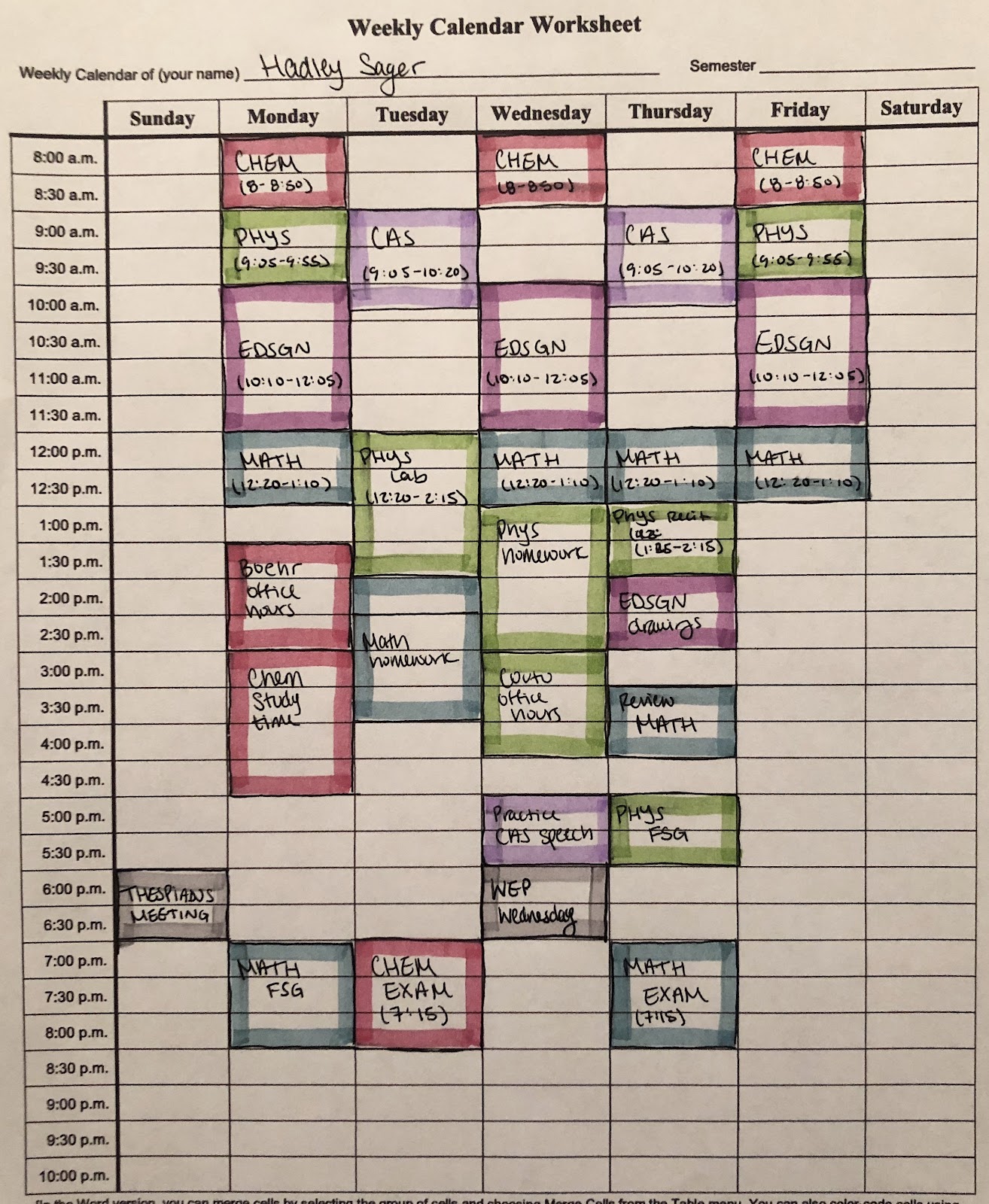
Printable calendars give you a customizable timetable that you can put on your bulletin board, in your notebook, or in your pocket. The main advantage to these is that they give you an hour-by-hour look at your day. Think Google Calendar but on paper. I find this method especially helpful during exam weeks. I can schedule when I’m going to study for each subject, what classes and meetings I have to go to, and office hours I want to attend all on one sheet. First, print out a blank weekly calendar and gather your most colorful set of pens and pencils. A helpful template can be found here. Then, add your classes to your schedule. I recommend assigning each class a specific color and filling in each class square so they stand out on the page. Now, you can draw in any meetings and study groups you want to go to. If you need some extra help in a class or want to chat with a professor, you can draw their office hours into your schedule. Make sure to assign the office hour blocks the same color as the class! The blank spots are your study and break times. If it works for you, draw in when you are going to work on each subject. You should now have a master sheet for your commitments that week! I find that having this master sheet makes me less likely to procrastinate or forget about a meeting. Yes, it does take some work to set up, but the result can be extremely helpful. 


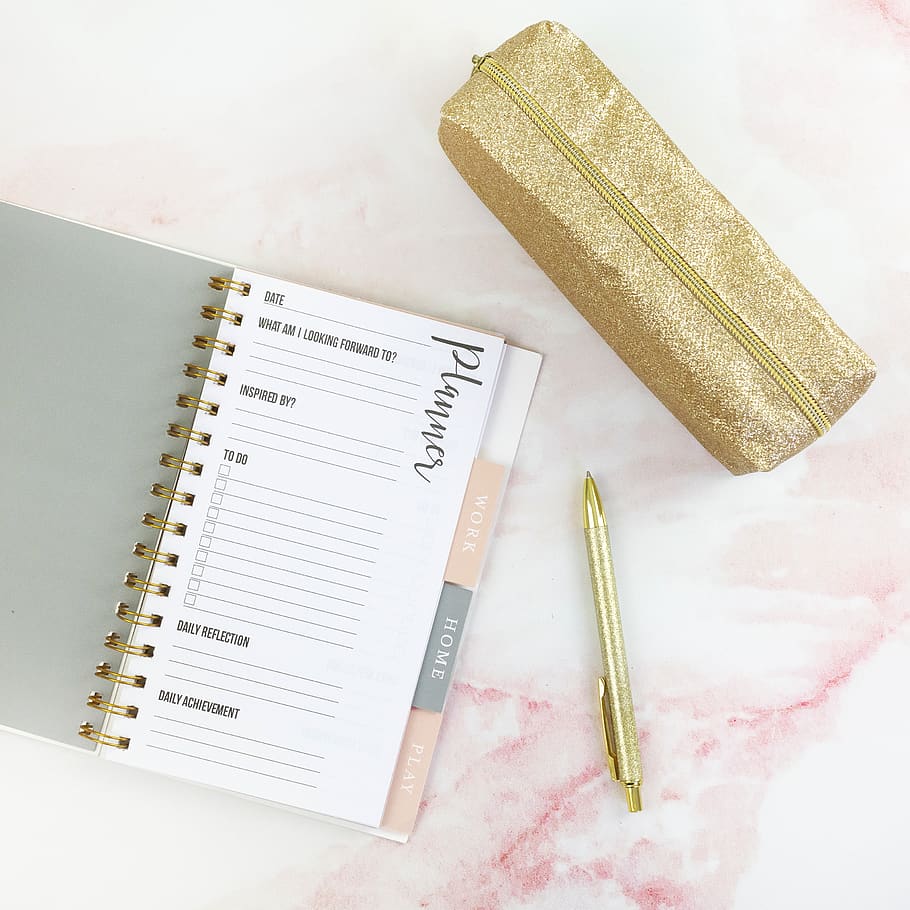
Store-bought planners can be a great resource to help you keep up to date on assignments. And let’s face it, who doesn’t love the satisfaction of physically crossing off a task on their to-do list. These planners are often organized by having a monthly calendar and then a weekly calendar with room to write assignments. Some will even have a daily schedule as well. Many planners have spaces for you to write goals and reflect on what happened that day. I recommend you search the internet to find the planner you like the best. The biggest advantage to a store-bought planner is that it is ready to use the minute you get it. You don’t have to worry about filling in blocks or designing a layout like you would with a printable calendar or a bullet journal. However, you are stuck with whatever layout your planner comes with. If you are like most people and this is not a problem for you, then a store-bought planner is an excellent option! They’re a simple and effective way to stay on top of your tasks without too much work (plus the patterns can be super cute). Here are some planners that your WEPO mentors love: Blue Sky Planners, Passion Planner, Orange Circle Studio, Vera Bradley Planners, Lilly Pulitzer Planners.  


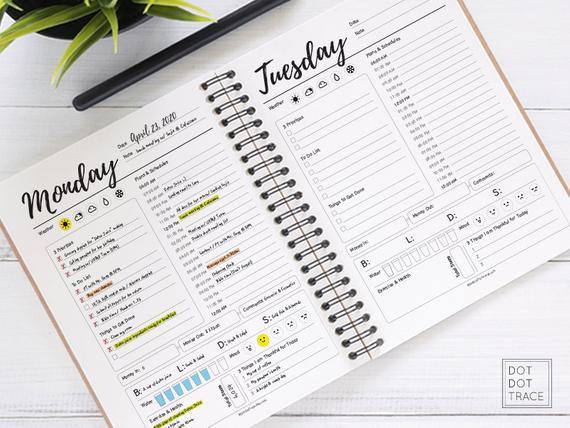
Bullet journals are highly customizable planners that can hold your calendars, assignments, goals, habits, or thoughts. As a disclaimer, this method can be very time consuming, but you will end with a journal that is completely personalized to fit your needs. The basic format most people follow is starting with a yearly calendar, or future log, then having monthly and weekly spreads. Often, people will include habits that are tracking sleep and exercise. Pinterest and Instagram have a ton of great ideas for your journal with lots of color and fun designs. If you googled bullet journals for the first time and thought, “I am definitely not artsy enough to do this,” don’t be scared! Bullet journals can be as elaborate or as minimalistic as you would like. My biggest advice for people who are trying bullet journaling for the first time is make one month and see if you like it. If a certain spread is not working for you, change it up! Even after three years of bullet journaling, I still like to change to my layout when I get bored of it. I like to make my layouts one semester at a time. I start with my course schedule and then make a monthly calendar. After each month, I have my weekly spreads. This gives me a structured planner, but it also leaves many pages for me to write notes, jot down my thoughts on the day, and get a little creative with collages and doodles. If you’re looking for a place to start, check out bulletjournal.com. It will give you a basic tutorial on how to bullet journal and they even have a journal you can buy that has guidelines on how to start. The most popular blank notebooks to use are the Leuchtturm1917 or Moleskin journals with either grid or dotted paper. Just have some fun with it and do you!


When choosing an organization method, think about what works for you. Do you like a strict schedule to stick to? Try the printable calendar. Do you want a ready-to-go organization system that many people love? Try a store-bought planner. Do you want a personalized planner that you can also use as a journal? Try bullet journaling! Go with the choice that works for you. 

Hadley Sager
Team B Envoy